Here is the promotional flyer sent out campus-wide by email:
Tuesday, December 13, 2016
Motives: A Curated Show by Josh Evans and Emily Wickizer
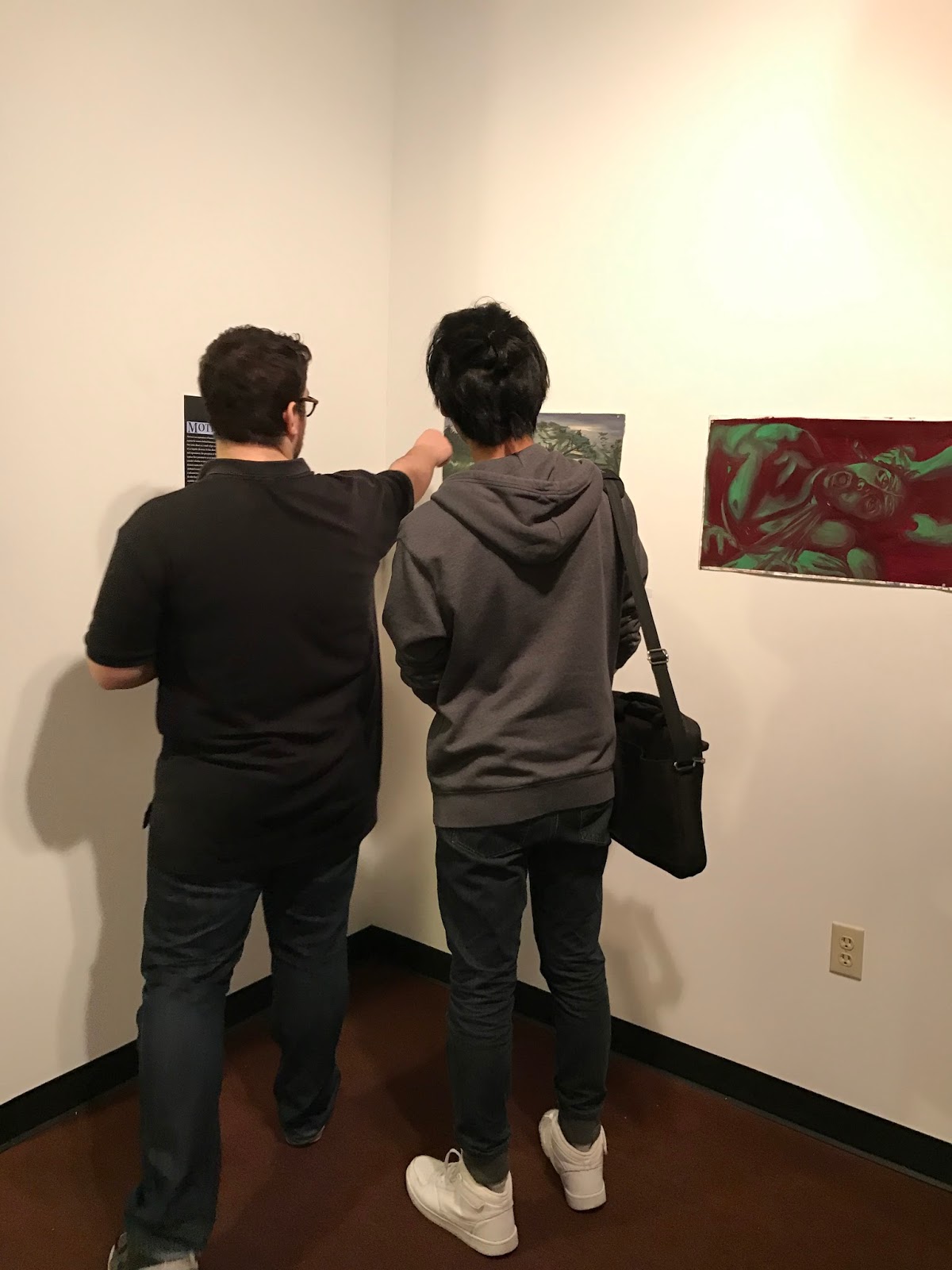
Here are a couple of images to document the set-up as well as the opening of our show, which took place on Wednesday, November 9th at the Lycoming College Campus Art Gallery. Our show was titled "Motives" and dealt with the motivation behind human action, questioning if there is necessarily always a defined motive behind the things people choose to do. The show included eight photographs by Penn College graduate Dallas Tyree, two paintings by Lycoming College student Mariah Deparasis, two paintings by Lyco student Jennifer Carter, and a video by Lyco senior Sophie Herzing.
Special thanks to Dallas, Mariah, Jennifer, and Sophie for allowing us to use their work, and thank you as well to all who attended the show.
Tuesday, November 8, 2016
Peek-A-Boo
PEEK-A-BOO
An Experience Curated by Jessica Tayson and Joe Troxler
BEFORE
(visiting artist's studios)
AS WE ARE SETTING UP
(filling out condition forms)
!!!THE OPENING!!!
(SO EXCITED)
Just a final note and thank you to everyone who has made this possible!
Monday, October 24, 2016
Lingers - by Jonathan Rummel and Nam Do
LINGERS
A curated show by Jonathan Rummel and Nam Do
October 19th - 21st, 2016
At Lycoming College Campus Gallery
Gallery talk on October 19, 2016, at 2:15pm
Curatorial Statement
There
are instances when we experience fleeting images of inconsistency or anomaly in
the surroundings. In more unfortunate cases, such illusions might deceive our
minds and skew our perceptions to the point where we could no longer get a grip
on reality. In essence, these all are mere fabrications of our imagination,
which ultimately derive from the experiences of our past.
Addressing
this idea, Lingers explores the use
of transient imagery and ethereal twists in visual arts as a means of
narrative, or clues as to the ingrained and sometimes hidden layers of meaning.
In reading these incorporeal elements, the viewer shall gain a deeper insight
on how they are shaped by personal experiences, visions, and emotions.
Featured Artwork
Artist and photographer Ralph Wilson drew his inspiration from The Yellow Wallpaper, an 1892 novel by American writer Charlotte Perkins Gilman, in creating an extraordinary series of artwork with the same name. Wilson’s series consists of five black and white photographs that narrate the story of a woman who underwent a therapy called “rest cure,” which essentially employed under-stimulation. The yellow wall-paper depicts the woman imagining people behind the wallpaper and how her mental problem escalated as time went by.
From
left to right:
A great many women - digital print on paper, 14 ¾” x 13 ½”
It was moonlight - digital print on paper, 15 ¼” x 12 ¾”
I suppose - digital
print on paper, 14 ¾” x 10 ¾”
Out at last - digital print on paper, 13 ¼” x 13 ¼”
Right across my path - digital print on paper, 13 ¾” x 13 ½”
In 2010,
Aaron Morgan Brown created the painting Armistice
Day, in which a young girl was holding a doll with both arms, while on the
window glass behind her were the reflection images of bombs suspended in
mid-air. The paradoxical stillness in Armistice
Day, as in many others of Brown’s work, reminds us of the nature of an
armistice – a temporary suspension – and that under such circumstances, peace
can be shattered at any moment.
Armistice Day - oil on panel, 12” x 8”
Tulu
Bayar, a Turkish born American artist, chose to address the theme of identity
in her series of mixed-media work, Invisible
(2011). Featured in Lingers is the video taken directly from this series. It
presents the Turkish marbling techniques and occasionally the revolving figure
of a person, the two seemingly disjointed yet deeply interwoven. Combining
traditional elements with a contemporary examination, Bayar opens up a dialogue
on exoticism, Orientalism, and the western perceptions of the Islamic identity.
Invisible - High definition video, duration 3:38
The
exhibition also features artwork by Emily Wickizer, a senior at Lycoming
College. Her Underwater City (2015) deals with the idea of individual
perspectives and how they are shaped by the surrounding environment, each
person’s upbringing and past experiences. Another work by Wickizer, Two Ghosts (2014) examines identity, capturing
the vaporous figures that represent two facets of a personality: the perception
of the self, and the projection of the self.
From left to right:
Two Ghosts - digital print on paper, 11" x 8"
Underwater City - digital print on paper, 11” x 8 ½”
Promotions
![]() |
| Flyer/Gallery guide's front page, attached to mass e-mail and posted around campus |
Gallery guide's back page (available at the exhibition only)
Other pictures
The curatorial statement on poster paper, 36" x 24"
People showed up for the opening and the gallery talk
There's the wall with Invisible (2011)
We were talking to the audience about the work
Many thanks to:
Ralph Wilson, Tulu Bayar, Aaron Morgan Brown, Emily Wickizer for allowing us to exhibit their art
Seth Goodman, Jeremiah Johnson for great advices and tips
Ann Piper for lending us artwork from her collection
Rosemarie Dirocco, Anh Tran, Zachary High for their feedback
and all those who came to support us and our exhibition.
Thursday, September 8, 2016
Student's Virtual Exhibition: Lands of Promises and the Broken Ones
Since the industrial revolution, big cities have been attracting more and more people with their offering of job opportunities, higher income, better living conditions, healthcare, and education, etc. However, awaiting in these cities are not only dreams and happy endings. The exhibition Lands of Promises and the Broken Ones addresses the starkly different living conditions within metropolises in order to expose the omnipresence of social inequality in the contemporary age, which have remained mostly unknown to the general public.
What factor, if any, could have accounted for this "lack of awareness?" Could it be the impression of mainstream media? The development of the tourism industry? Administrative negligence? Or something else? The viewers shall immerse themselves in a myriad of contradictions to gain a broader perspective on this issue and may develop their own personal standpoints.
The exhibited pieces were gathered from Google image searches or are screenshots of Google search results. As the keywords slightly changed, the search engine returned a completely different set of results; however, a pattern will prevail as the viewer walk through the exhibition.
Sometimes “seeing the big picture” is not
enough. The image above is one great example of the many Google image results
for “NYC.” Now, zoom in a little. Change the keyword to “Brownsville NYC,” and you
will find images such as the one to the right.
1.Google search: London; 2,3.Google search:
Hackney London
Advertising
banner of Mumbai: the city of allure
Mumbai
houses the largest slum in Asia: the Dharavi.
As the
demand for new, unique experiences continued to evolve, a new term came to
existence: Slum tourism. This model
originated from the 19th century, at the time focusing on Manhattan
and London areas.
1. Google search: San
Francisco; 2,3,4. Tenderloin San Francisco
Wednesday, September 7, 2016
Nicole Gerling's Virtual Gallery: Pricey Power and Finesse
Artist Statement:
Lacrosse was discovered in the 1630s, Native Americans played with sticks called crosses and wooden or deer skin balls that were made by the players. Now, sticks, gloves, helmets, goggles, and balls are all made in mass production. Costing hundreds of dollars just to step on the field. Girls can easily spend two hundred; boys depending on their position can spend five hundred and goalies for men and women about the same. There is also the safety factor; most teams demand the players to have a special insurance just for lacrosse related injuries and the higher price of equipment is considered safer. Why would someone buy cheap gear when a hard rubber ball is flying around at high speeds? Basically making the user pay more just to have a safer game experience. This sport has turned into a rich kids sport, turning away everyone that could not easily put down hundreds to experience the rush.


Tuesday, September 6, 2016
Emily Wickizer's Virtual Exhibition: Mammals
Mission Statement: The
show Mammals seeks to make a
comparison between human and non-human mammals by portraying a variety of
non-human mammals exhibiting behaviors that indicate some type of “human”
characteristic. The viewer is encouraged to consider these characteristics and
question why we typically think of them as being related first and foremost to
humans. Have all of the creatures in this collection somehow been exposed to
humans enough to pick up on their behavior and mimic them in their own
behaviors, or are these characteristics more universal to the entire animal
world? Through physical actions, patterns of social behavior, and facial expressions indicating emotion, Mammals seeks to challenge the notion
that
humans and other animals are more different than they are alike.
Thursday, September 1, 2016
Subscribe to:
Posts (Atom)