Curatorial Statement
Women are relentlessly given a variety of molds that they are expected to fit into from a young age, often that they must be the thin, friendly, smiling companions to their masculine counterparts. These expectations are demeaning and underestimate the fire within every woman.
The Struggle of Femininity includes carefully selected artwork by Amy Abbatoir, Tulu Bayar, Aaron Morgan Brown, and Ann Piper, and feature women of various races and body type. The artwork is large, and purposefully designed within the gallery so that the viewer cannot ignore the confident stares of the women in the paintings. The subjects seem to say, “Is this what you wanted? Am I your perfect lady now?” Slight viewer discomfort is intentional, and is a deliberate attempt to share the daily discomfort many women experience. Stares, overbearing expectations, and judgment are too often the norm, and the women in the artwork are finally able to expose either their true selves or what attempting to adhere to expectations have caused them to become.
Women are more than a delicacy to be enjoyed. Every woman has a struggle within, whether it is emotional stress, sexuality or sexual habits, racial identity, or even the concept of gender itself. At times, their own selves become aliens in the mirror, and their own eyes are judgmental.
The Struggle of Femininity is an opportunity for women to reclaim their own femininity. Each woman has their own femininity that they struggle to define within themselves and without societal interference.
Artwork
 |
| Red Self Oil on canvas Amy Abbatoir |
 |
| Blue Self Oil on canvas Amy Abbatoir |
 |
| Green Monster Oil on canvas Amy Abbatoir |
 |
| Tosha and Dawson Oil on canvas Ann Piper |
 |
| The Enthusiast Oil on canvas Aaron Morgan Brown |
 |
| Spill 1 Channel Video Projection Tulu Bayar Watch here |
Art before Installation and Installation Issues


 |
| We brought our flatscreen television into the gallery in order to play Tulu Bayar's Spill, but the pedestal desperately needed to be repainted white, instead of the strange light teal color it originally was. Here is the finished product. |
We originally had a design of where everything was to go, but before measuring out where the nails were to go, we placed the artwork against each wall that we anticipated placing them. Amy Abbatoir kindly framed her three painting, but informed us that the frame for Green Monster was warped, and said that we could do anything to make the piece hang correctly. With some quick thinking, we added two dots of hot glue on two corners of the wooden frame, and it was the perfect solution! The walls were not damaged, and the frame looked as good as new upon de-installation. Another installation issue that presented itself was the large size of Ann Piper's painting, Tosha and Dawson. We first used a nail in the same manner that we did for all of the other paintings, but the wire and sheer size and weight of the painting made the nail inferior. We found a power drill and screw in the storage room/bathroom, and took the plunge into our first experience with power tools. It worked perfectly! The exposed grooves of the screw provided a secure place for the wire of the painting to rest.
Artwork within the Gallery and Exhibition Design
 |
| View upon entering the gallery, with Blue Self above the curatorial statement. |
 |
| The three paintings by Amy Abbatoir. |
 |
| Tosha and Dawson had a wall to itself. |
 |
| The opening day was rainy and dark, and added to the serious nature of the show. |
 |
| A view of The Enthusiast and Spill. |
Something that Jenny and I were very concerned with was that each work would be able to be powerful to the viewers, while surrounded by other strong pieces. The Enthusiast was slightly different from the other works in our show, as the woman was wearing a mask. However, this became reminiscent of the "alien in the mirror" referenced in our curatorial statement, and the viewers also reacted positively to its inclusion and imagery.
We were the only co-curated show to include a video, and we wanted to make sure that it would have the same impact on casual viewers as it did on us when we first viewed it. The video itself features a woman's eyes staring, winking, blinking, and crying. The background music is almost primal, but also serious. The inclusion of the video added an incredible dynamic to the exhibition, and the show would not have been the same without it.
Images from the Opening and Gallery Talk
 |
| During the gallery talk. |
 |
| Many viewers were drawn to the eerie and intriguing nature of The Enthusiast. |
 |
| Interactive component |
 |
| Instructions for the interactive component of the exhibition |
Jenny and I wanted to have our viewers thinking about their own identity and how they are seen by other before they even entered the gallery space. Therefore, we supplied pens, index cards, pushpins, and a cork board for the index cards to pinned to. Through this interactive practice, the viewers created their own artwork.
 |
| Promotional Poster |
We had originally planned on The Enthusiast to be featured on our promotional materials. However, due to the strong stares and our finished curatorial statement, it was decided that the eyes from the Abbatoir paintings would be used. For the promotional poster, two sizes were created. We had two copies of the large version printed, with one attached to the front doors of the art building, and the other on the door leading into the Lycoming College Campus Art Gallery. Forty copies of the 8.5x11 version were printed on white cardstock paper and hung in various, well-traveled areas of campus: Wertz, the art building, throughout Pennington Lounge, the Academic Center foyer, in the stairwells within the AC, on the 200 and 300-level floors, as well as the psychology floor (which is below the ground floor of the AC). Jenny and I received positive comments regarding our promotional poster from Dr. Kathryn Ryan, a professor in both the Psychology and Women and Gender Studies departments.
We specifically used the last four sentences of the curatorial statement in order to draw in even the most unlikely of viewers (such as those who may be turned off by a very feminist show). In addition, we felt that the final four sentences of the curatorial statement was a succinct explanation of the exhibition and a way to begin a dialogue about the show, even before its opening.
 |
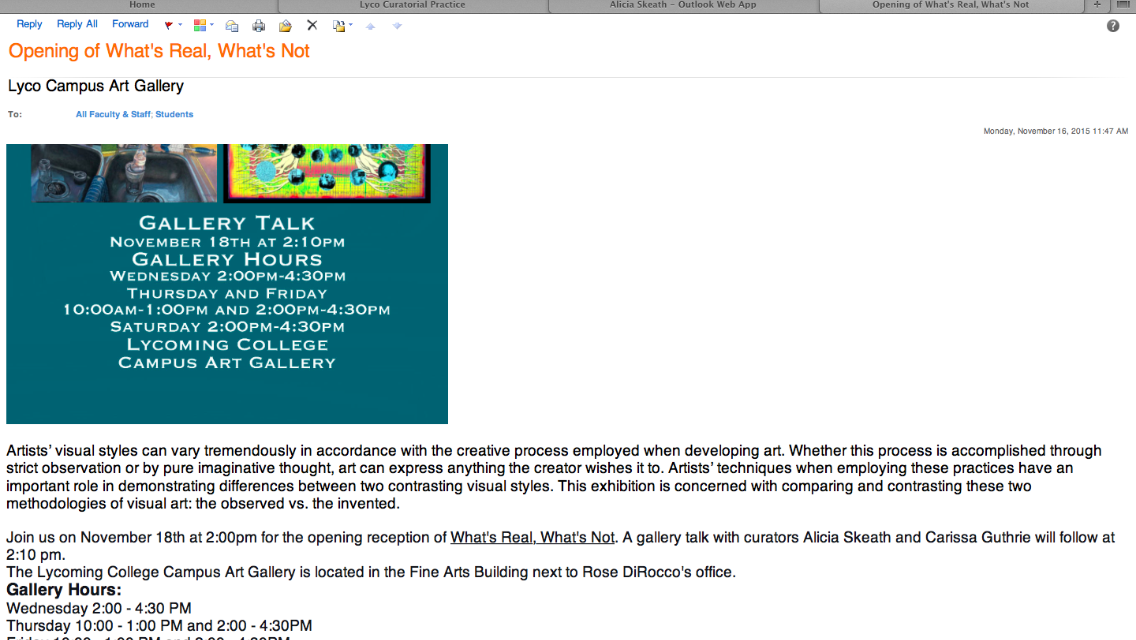
| Campus-wide promotional email |
Our campus-wide email just made the deadline for its release 24 hours prior to the show opening. Technological issues had abounded, but we persevered.
 |
| Facebook event |
We created a Facebook event, which included our curatorial statement and the gallery hours. We invited as many people as possible, and even more people attended than had marked "Going"! The event is public, and can be viewed at: https://www.facebook.com/events/913652652003246/
Thank You Notes
Though we do not have images of all of the thank you notes we wrote to the artists and other members of the campus community who helped us.